
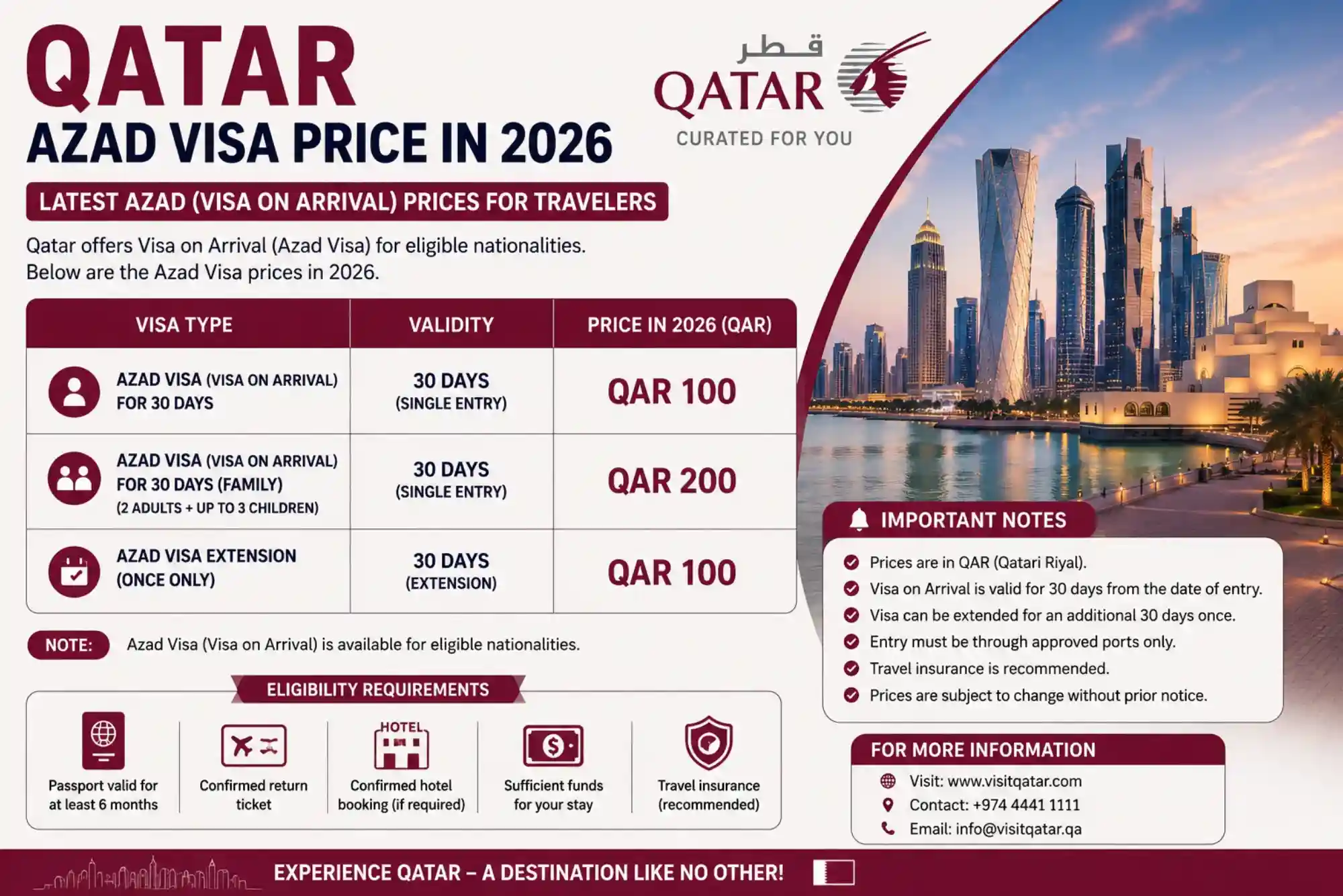
The concept of an “Azad visa” in Qatar has gained significant traction among freelancers, remote workers, and job seekers who want to live in Qatar without being tied to a single employer. In 2026, understanding the real Qatar Azad visa price is more important than ever, as fees and regulations have seen subtle but important updates. This guide provides a complete, transparent breakdown of all costs involved—so you can budget accurately and avoid unexpected expenses.
What Is a Qatar Azad Visa?
Before diving into the pricing, it is essential to clarify what an Azad visa actually means in the Qatari context. The term “Azad” (meaning “free” in several South Asian languages) refers to a residency visa that is not sponsored by a conventional employer. Instead, individuals obtain a visa through a second-party sponsor—often a company that provides sponsorship for a fee—allowing them to live and work in Qatar freely. This arrangement is particularly popular among consultants, small business owners, and those between jobs.
In 2026, the legal framework around freelance and self-sponsored visas has become more structured. The government has introduced clearer categories, which means the visa price now varies based on duration, profession, and type of sponsorship. For travelers and expats planning their move, it is wise to understand all financial layers, including service charges, medical fees, and ID costs.
Qatar Azad Visa Price 2026: Complete Fee Table
The table below outlines the updated fees for different Azad visa packages in Qatari Riyal (QAR) and approximate US Dollar equivalents. These figures are based on current service provider rates and official government fees as of early 2026.
| Visa Type | Duration | Sponsorship Fee (QAR) | Government Fees (QAR) | Medical & ID (QAR) | Total (Approx) |
|---|---|---|---|---|---|
| Basic Azad Visa | 1 year | 4,500 – 5,500 | 1,200 | 600 | 6,300 – 7,300 |
| Premium Azad Visa (with health insurance) | 1 year | 6,000 – 7,000 | 1,200 | 1,100 | 8,300 – 9,300 |
| Freelancer Self-Sponsor Visa | 2 years | 8,500 – 9,500 | 2,000 | 1,000 | 11,500 – 12,500 |
| Family Add-on (per dependent) | 1 year | 2,000 – 2,500 | 500 | 500 | 3,000 – 3,500 |
Detailed Cost Breakdown for 2026
Understanding each component of the Qatar Azad visa price 2026 helps you avoid hidden charges. Here is what every fee covers.
Sponsorship Service Fee
This is the largest variable cost. A local Qatari company or individual acts as your nominal sponsor. They charge an annual fee ranging from QAR 4,500 to QAR 9,500 depending on services included (e.g., document clearing, PRO support, or office space access). Never pay the full amount upfront without a stamped contract.
Government Issuance Fees
These are non-negotiable and paid to the Ministry of Interior and Immigration Department. In 2026, the standard visa issuance fee remains QAR 1,200 for a one-year permit. Two-year permits require QAR 2,000. These figures include the residence stamp and electronic registration.
Medical Examination and Biometrics
Every applicant over 18 must undergo a medical test (chest X-ray and blood screening) at an approved health center. The cost is approximately QAR 400 to 500. Biometric fingerprinting and ID card registration add another QAR 200. Overall, budget around QAR 600 for a single applicant.
Health Insurance (Optional but Recommended)
While not mandatory for all Azad visa types in 2026, many sponsors now require basic health insurance. A minimum policy costs QAR 500 to 700 annually. Premium packages with dental and outpatient coverage go up to QAR 1,500.
Hidden Costs to Watch Out For
Experienced expats often warn about unexpected expenses that increase the final Qatar Azad visa price. Common ones include:
Document legalization: If your educational certificates or marriage documents need attestation from the Qatar embassy in your home country, this can cost QAR 300–800 extra.
Bank account opening deposit: Some sponsors require you to open a local bank account with a minimum deposit of QAR 2,000 to QAR 3,000.
Renewal markup: Second-year renewal fees are often 10–15% higher than first-year sponsorship charges. Always ask for a renewal cap in writing.
When planning your move, it’s also wise to browse general travel cost guides. For example, understanding pricing trends across different destinations can help you compare Qatar’s visa costs with other Gulf countries.
How the Azad Visa Compares to Traditional Employment Visas
A standard employer-sponsored visa in Qatar costs the company between QAR 3,000 and QAR 5,000 in government fees, but the employee pays nothing directly. However, the trade-off is restricted mobility. With an Azad visa, you pay more upfront but gain the freedom to work for multiple clients or change jobs without needing a new sponsor. For freelancers and digital nomads, this flexibility often justifies the higher price.
If you are exploring other travel-related financial planning, such as budgeting for accommodations or daily expenses, consider reading practical advice like best place to stay in Coffs Harbour to understand how location affects cost of living—though that example is for Australia, the principle of researching local prices applies universally.
Application Process (With Cost Timeline)
Knowing when each payment is due prevents last-minute surprises. Here is the typical sequence in 2026.
Find a Registered Sponsor (Week 1–2)
Initial service fee deposit: QAR 1,000–2,000 (non-refundable in most cases).
Submit Documents for Entry Visa (Week 2–3)
Government processing fee for entry visa: QAR 500. Total paid so far: QAR 1,500–2,500.
Arrive in Qatar and Convert to Residency (Week 3–4)
Remaining sponsorship balance + medical fees + ID card fees: approximately QAR 5,000–6,000 for a basic visa.
Total average cost upon completion: QAR 6,500–8,500 for the first year.
Many visitors arriving for visa conversion also look for short-term accommodations near metro stations for convenience. For instance, knowing the location and accessibility of Al Fahidi Metro Station Exit 3 can be helpful if you are transiting through Dubai first, but in Doha, the metro system is similarly expanding near visa processing centers.
Who Should Avoid the Azad Visa?
The Azad visa is not for everyone. If you have a stable, long-term job offer from a reputable Qatari company, the traditional visa is cheaper and legally simpler. Additionally, individuals with families should carefully calculate costs because dependents add QAR 3,000–3,500 per person annually. Some professionals also find that certain industries (like oil & gas or government contracting) do not recognize Azad visa holders for on-site projects.
Before committing, research other ways to manage finances and travel logistics. For example, even unrelated topics like finding the right automotive machine shop near me highlight the importance of verifying service providers—a principle that applies equally to choosing a visa sponsor.
Legal Updates for 2026: What Changed?
Three significant changes affect the Qatar Azad visa price in 2026:
- Digital ID integration: The new digital residency card (QID) now costs QAR 200 instead of QAR 150 previously.
- Remote work visa overlap: Qatar’s official remote work visa now costs QAR 1,000 per year, but it does not allow local employment. Some Azad visa providers have lowered their fees to compete.
- Penalty increases: Overstaying an expired Azad visa now incurs QAR 50 per day (up from QAR 35 in 2024). Always renew at least two weeks before expiry.
Frequently Asked Questions About Azad Visa Pricing
Is the Qatar Azad visa price the same for all nationalities?
Sponsorship fees are generally the same regardless of nationality. However, nationals from countries with bilateral agreements may pay slightly lower government fees (around QAR 200–300 less).
Can I pay the total amount in installments?
Some sponsors offer 3–4 month installment plans, but they typically add a 5–8% administrative charge. Always get a signed installment agreement.
Do I need a lawyer to process an Azad visa?
No. Licensed visa service providers (called “tycoon” companies) handle everything legally. Lawyers are only necessary if you face a legal dispute with your sponsor.
Final Verdict: Is the Azad Visa Worth the Price in 2026?
For independent professionals earning a stable income from overseas clients or multiple local gigs, the Azad visa remains the most practical route to long-term residence in Qatar. The total cost of QAR 6,500 to 12,500 annually is comparable to similar freelance visa schemes in Dubai and Bahrain. However, always verify your sponsor’s credentials through the Ministry of Commerce and Industry before paying any significant fee.
Travelers and expats who keep themselves informed about diverse locations and logistical tips tend to make better financial decisions. Whether you are calculating visa costs or planning leisure activities like the 7 best hikes near Jeju City, breaking down expenses into transparent categories always helps. Use the pricing table above as your reference, and never hesitate to negotiate service fees with multiple sponsors.
Related Reading: Romania Visa Price in 2026: Updated Fees and Price Breakdown
Related Reading: South Africa Visa Price in Nigeria in 2026: Updated Fees and Price Breakdown
Related Reading: Singapore E Visa Price in 2026: Updated Fees and Price Breakdown
Related Reading: Russian Transit Visa Price in 2026: Updated Fees and Price Breakdown — full guide
Related Reading: Qatar 2 Year Visa Price in 2026: Updated Fees and Price Breakdown
Related Reading: Qatar Work Visa Price in Pakistan in 2026: Updated Fees and Price Breakdown