
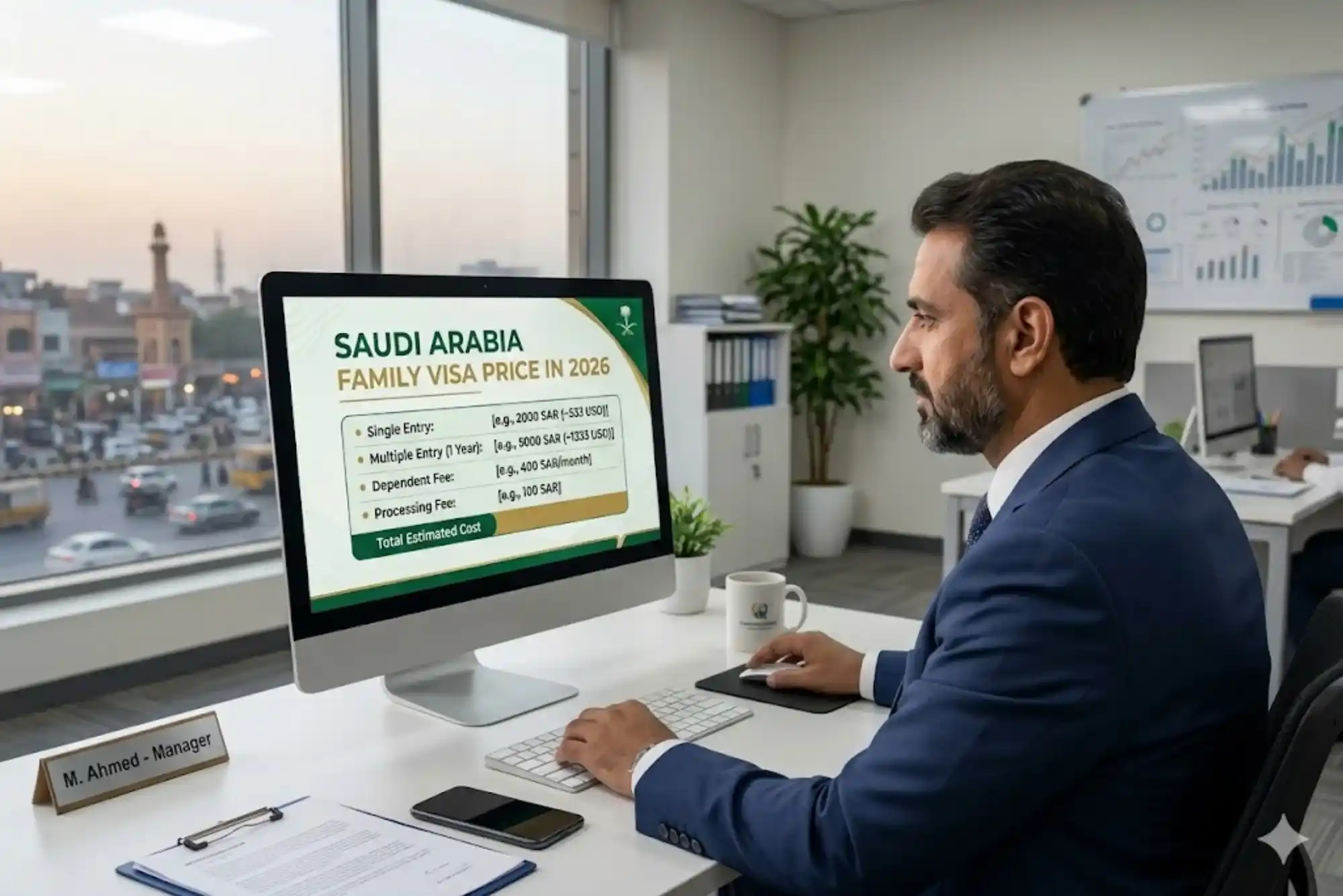
Bringing family members to Saudi Arabia is one of the most important steps an expatriate resident takes after settling into their role, and getting the cost planning right from the start makes the entire process significantly less stressful. The Saudi Arabia family visa price in 2026 is not a single fee — it is a combination of multiple government charges, service centre costs, medical examination fees, insurance premiums, and Iqama issuance costs that together determine the total financial commitment involved in sponsoring a spouse, children, or parents to join you in the Kingdom. This guide breaks down every component clearly so you can budget accurately before beginning the process.
What Is the Saudi Arabia Family Visa?
The Saudi Arabia family visa — officially a dependent residence visa — is issued to the spouse, children, and in some cases parents of an expatriate resident (Iqama holder) who is legally employed and residing in the Kingdom. The sponsoring resident applies through the Ministry of Interior’s Absher platform or through a local typing and service centre, and upon approval, the family member enters Saudi Arabia on a family visa entry stamp which is then converted to a resident Iqama (residence permit) after completing the necessary medical and biometric formalities in-country.
The family visa system in Saudi Arabia has been progressively digitised through the Absher platform, and most transactions — from initial application to Iqama renewal — are now conducted online or through Tawasul service centres. Understanding the full Saudi Arabia family visa price requires following the cost chain through each of these stages.
Saudi Arabia Family Visa Price: Complete Fee Breakdown for 2026
The total cost of sponsoring a family member to Saudi Arabia involves fees at multiple stages — pre-arrival, arrival, and post-arrival. Each fee is charged by a different authority and paid through different channels.
| Fee Component | Estimated Amount (SAR) | Approximate Amount (USD) | Paid To / Channel |
|---|---|---|---|
| Family visa issuance fee (entry visa) | 200–300 SAR | Approx. $53–$80 | Ministry of Interior via Absher or service centre |
| Iqama issuance fee (residence permit) | 500–800 SAR per year | Approx. $133–$213 | Ministry of Interior; varies by dependent type and sponsor salary |
| Medical examination fee | 200–400 SAR | Approx. $53–$107 | Approved medical centre in Saudi Arabia |
| Health insurance premium | 600–2,000+ SAR/year | Approx. $160–$533+ | Approved Saudi health insurance provider |
| Biometric registration fee | Included in Iqama process | — | Ministry of Interior biometric centres |
| Service centre / typing fee | 100–200 SAR | Approx. $27–$53 | Tawasul or Absher typing centres |
| Muqeem registration fee | Typically 50–100 SAR | Approx. $13–$27 | Ministry of Interior via Absher |
Iqama Fees: The Largest Ongoing Cost Component
The Iqama — the official Saudi Arabia residence permit — is the primary ongoing cost of maintaining family members’ legal residency in the Kingdom. The Iqama fee structure for dependents changed significantly in recent years and is now tiered based on the number of dependents a sponsor is maintaining and, in some cases, the sponsor’s salary level and employment category.
For Saudi Arabia family visa holders in 2026, the annual Iqama fee per dependent is structured as follows under the current system. Sponsors with a monthly salary below SAR 5,000 may face a surcharge on the standard dependent Iqama fee. Sponsors employed by government entities or Saudi Aramco typically benefit from employer-subsidised Iqama costs for their families. Private sector employees are responsible for the full cost unless their employer provides a housing and family allowance that covers these expenses.

| Dependent Type | Annual Iqama Fee (SAR) | Notes |
|---|---|---|
| Spouse | 500–800 SAR/year | Varies by sponsor employment category and salary bracket |
| Child (under 18) | 500–800 SAR/year each | Same fee applies per child regardless of age under 18 |
| Dependent adult child (18–25, student) | 600–1,000 SAR/year | Student status must be documented annually for continuation |
| Parents (where permitted) | 800–1,200 SAR/year each | Parent sponsorship subject to eligibility requirements; higher fee bracket |
These annual fees are paid at the time of Iqama renewal each year and are non-negotiable government charges. Failure to renew on time results in daily overstay fines and complications in renewing dependent visas, so tracking renewal dates is an essential part of managing the ongoing Saudi Arabia family visa cost.
Medical Examination Fees for Saudi Arabia Family Visa
Every family member entering Saudi Arabia on a dependent visa must undergo a medical fitness examination at an approved medical centre in the Kingdom after arrival. The medical test screens for communicable diseases including tuberculosis, HIV, and hepatitis, and a clean fitness certificate is required before the Iqama can be issued.
Medical examination fees at Saudi Ministry of Health-approved centres typically range from SAR 200 to SAR 400 per person. The exact fee varies by centre, city, and whether the applicant chooses a standard appointment or a VIP/priority appointment. In major cities like Riyadh, Jeddah, and Dammam, results under the standard track are typically available within 48 to 72 hours. Priority appointments may yield same-day results at a higher fee. Children under 12 months are typically exempt from the medical examination requirement, but this should be confirmed with the relevant medical centre at the time of application.
Health Insurance: A Mandatory and Variable Cost
Saudi Arabia mandates that all Iqama holders, including family dependents, be covered by valid health insurance throughout their stay. The sponsor is responsible for providing health insurance for all registered dependents, and the Iqama renewal process requires active insurance to be in place before renewal is processed.
Health insurance premiums for family dependents in Saudi Arabia vary significantly based on the insurance plan selected, the insured persons’ ages, and the insurer. Basic cooperative health insurance plans that meet the Council of Cooperative Health Insurance (CCHI) minimum requirements typically cost SAR 600 to SAR 1,200 per person per year for a healthy adult. Comprehensive plans with wider hospital networks, specialist coverage, and dental or optical add-ons can reach SAR 2,000 to SAR 5,000 or more per person annually. Children’s plans are typically lower, starting from SAR 400 to SAR 800 per year depending on the insurer and plan tier.
For expatriates relocating families to different countries across the Middle East and managing multiple visa and residency processes, understanding employment contract structures in advance helps greatly in calculating what portion of these costs an employer may cover. A useful reference for understanding the employment contract types that typically govern what an employer provides in terms of family allowances and insurance can be found in resources discussing common employment contract types across Gulf countries.
Total Estimated Saudi Arabia Family Visa Cost Per Dependent in 2026
| Cost Category | One-Time / Annual | Estimated Range (SAR) |
|---|---|---|
| Entry visa issuance fee | One-time | 200–300 SAR |
| Medical examination | One-time (on arrival) | 200–400 SAR |
| Iqama issuance (first year) | Annual | 500–1,200 SAR |
| Health insurance (basic plan) | Annual | 600–1,200 SAR |
| Service centre / typing fees | One-time | 100–200 SAR |
| Estimated First-Year Total (per dependent) | — | 1,600–3,300 SAR |
| Estimated Annual Renewal Cost (per dependent) | — | 1,100–2,400 SAR |
These estimates are per dependent. A sponsor bringing a spouse and two children would multiply these figures accordingly, resulting in a first-year family visa cost in the range of SAR 4,800 to SAR 9,900 for three dependents before any employer contributions are factored in.
Pre-Arrival Costs: Document Preparation and Home Country Expenses
Before the family member travels to Saudi Arabia, several supporting documents must be prepared in the home country, and these preparation costs are part of the total Saudi Arabia family visa price that many sponsors overlook during their initial budget planning.
Attested marriage certificate: Required for spouse sponsorship. Must be attested by the home country’s foreign affairs ministry and the Saudi Embassy. Attestation costs typically range from USD 50 to USD 200 depending on the country and number of documents.
Birth certificates for children: Must be similarly attested. Cost per document varies by country.
Medical fitness certificate from home country: Some embassies require a basic health certificate from the applicant’s home country doctor before issuing the entry visa. Costs vary from USD 20 to USD 100.
Visa application at Saudi Embassy: In some countries, the family entry visa is applied for at the Saudi Embassy or consulate rather than purely through Absher. Embassy application fees vary by nationality but are typically equivalent to SAR 200 to SAR 300 in local currency.
Biometric enrolment (where required at home country embassy): Some Saudi Embassies collect biometric data before visa issuance. Fee is typically included in the visa application charge.
For families with multiple children or those requiring multiple attested documents, pre-arrival preparation costs can reach USD 300 to USD 600 before any in-Kingdom fees are paid. Factoring these into the total budget early prevents financial surprises at the critical point of the application process. For families who frequently travel internationally and need to manage travel-related expenses efficiently, guides on planning travel costs and navigating airport commercial options can be genuinely helpful — such as resources on managing duty-free purchases and travel retail costs at major international airports, which many families transit through when relocating to Saudi Arabia.
Dependent Iqama Renewal: Ongoing Annual Cost
Once the family is in Saudi Arabia with valid Iqamas, the annual renewal cycle becomes the primary recurring financial commitment. The renewal process for each dependent involves paying the annual Iqama fee, confirming active health insurance, and updating any documentation that has changed — such as a child’s school enrollment confirmation for student-age dependents.
Iqama renewal is processed through Absher and is typically straightforward when all documentation is current. Late renewal penalties of SAR 200 per dependent per month are applied if the Iqama expires without renewal, making timely processing financially important. For sponsors managing multiple dependents, setting calendar reminders for renewal dates three months in advance of each expiry is strongly advisable. For the most current official fee schedules, the website provides authoritative and up-to-date information on all Ministry of Interior residency fees that should be consulted before initiating any family visa application.
Frequently Asked Questions
Can a Saudi Arabia resident sponsor their parents on a family visa?
Parent sponsorship is permitted in Saudi Arabia under certain conditions. The sponsor typically must hold a high-salary position or meet specific criteria set by the Ministry of Interior. Parent Iqama fees are generally higher than for spouses and children. The application is processed through Absher and may require additional documentation including proof of financial capability and a valid health insurance plan covering the parents.
Does the sponsor pay the family visa fees or can the dependent pay?
All fees related to the family dependent visa and Iqama are the legal responsibility of the Saudi sponsor. While funds may come from any source practically, the sponsor’s Absher account is the official channel through which all Iqama issuances, renewals, and associated payments are processed. Failure to pay Iqama fees on time reflects on the sponsor’s residency standing, not just the dependent’s.
Is health insurance for family dependents provided by the employer in Saudi Arabia?
Saudi Arabia’s cooperative health insurance system requires employers to provide health insurance for their employees, but the legal obligation to cover employee dependents varies by employment contract and company policy. Many multinational companies and government-linked employers include family health insurance as part of the overall compensation package. Private sector employers, particularly SMEs, may limit their insurance obligation to the employee only, leaving the sponsor responsible for sourcing dependent insurance independently.
How long does the Saudi Arabia family visa process take from application to Iqama issuance?
The timeline from initial Absher application to the family member holding a valid Iqama in Saudi Arabia typically spans four to eight weeks under standard conditions. The pre-approval and entry visa stage takes five to fifteen working days through Absher. Medical examination results take two to five working days after arrival. Iqama printing and collection typically takes seven to fourteen working days after medical clearance. Urgent or priority processing options exist at some service centres for an additional fee.
The Saudi Arabia family visa price in 2026 ranges from approximately SAR 1,600 to SAR 3,300 per dependent in the first year, covering the entry visa, medical examination, initial Iqama issuance, health insurance, and service fees. For a family of three dependents — spouse and two children — the first-year total typically falls between SAR 5,000 and SAR 10,000 depending on the salary bracket and insurance plan chosen.
Annual renewal costs are lower, ranging from SAR 1,100 to SAR 2,400 per dependent. Planning for both the one-time entry costs and the recurring annual expenses is essential for accurate budgeting, and verifying the latest official fee schedules through Saudi Arabia’s Ministry of Interior Absher platform before initiating any application ensures you are working with the most current figures.
Related Reading: Qatar Azad Visa Price in 2026: Updated Fees and Full Price Breakdown
Related Reading: Saudi Arabia Visit Visa Price for Indian in 2026: Updated Fees and Price Breakdown
Related Reading: Price of Visa to Canada in 2026: A Complete and Detailed Cost Breakdown