
The challenge? Most store owners either rely on outdated keyword strategies or use tools incorrectly, chasing high-volume keywords that are nearly impossible to rank for. The result is predictable: wasted time, poor rankings, and missed revenue opportunities.
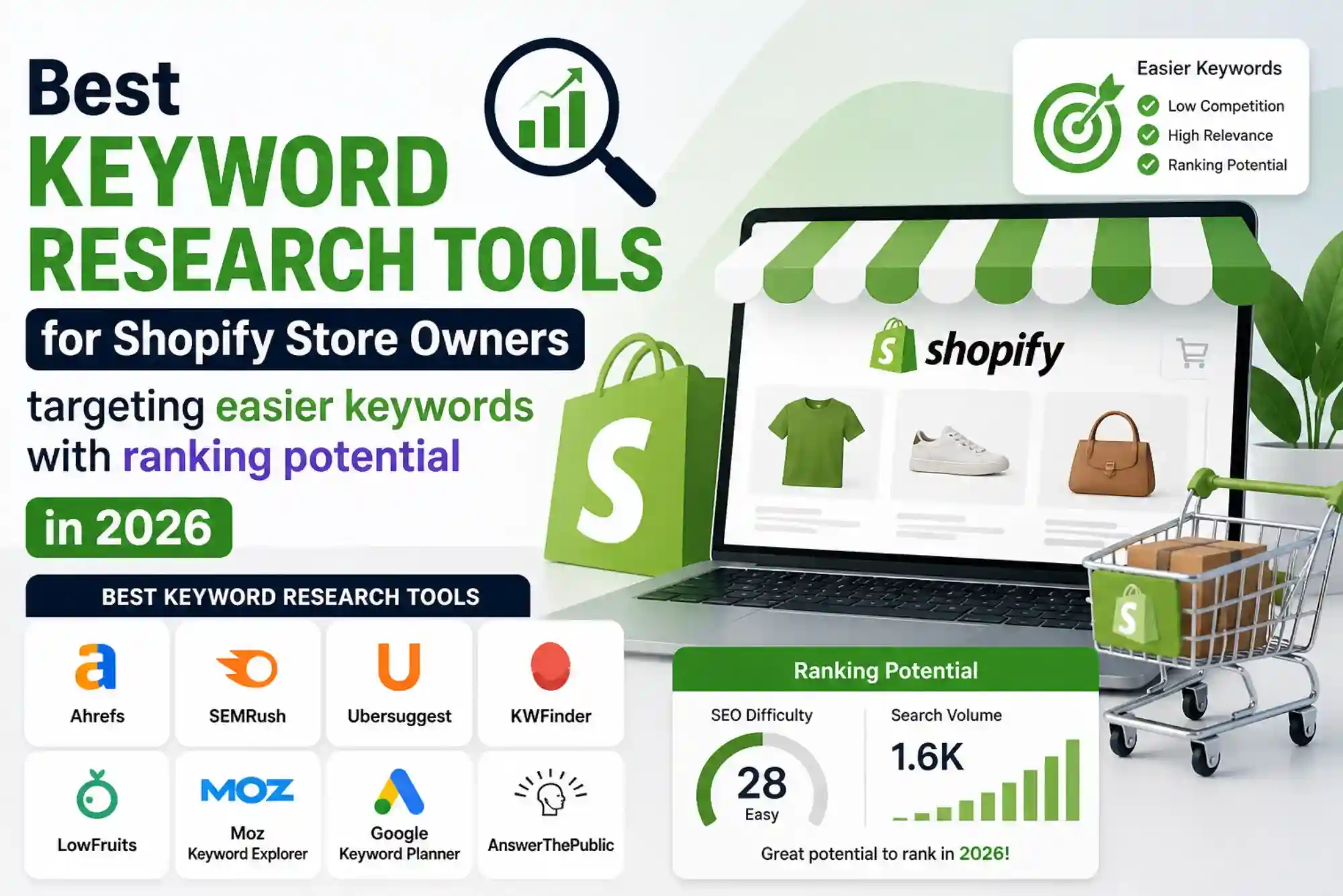
This guide breaks down the best keyword research tools for Shopify store owners in 2026, with a clear focus on finding easier keywords that actually convert. Whether you’re launching a new store or scaling an established one, these tools will help you build a smarter, more profitable SEO strategy.
Why Shopify Keyword Research Has Changed in 2026
Search behavior has evolved significantly. Customers are now using longer, more specific queries — often conversational — when searching for products. Instead of searching “running shoes,” they search for “best lightweight running shoes for flat feet under $100.”
This shift has created a major opportunity for Shopify store owners: long-tail keywords with lower competition but higher purchase intent.
Additionally, search engines prioritize content relevance, topical authority, and user experience more than ever. This means your keyword strategy must align with content structure, product pages, and internal linking.
What Makes a Keyword “Easy to Rank”?
Before diving into tools, it’s important to understand what defines an “easy” keyword:
- Low keyword difficulty: Fewer authoritative competitors
- Clear search intent: Users are ready to buy or take action
- Moderate search volume: Enough traffic without heavy competition
- Long-tail structure: More specific phrases with less competition
The best tools don’t just show search volume — they help you uncover these opportunities efficiently.
Best Keyword Research Tools for Shopify in 2026
1. Ahrefs – Advanced Competitive Keyword Intelligence
Ahrefs remains one of the most powerful tools for Shopify SEO. Its strength lies in competitive analysis and keyword difficulty scoring.
With Ahrefs, you can analyze competitor Shopify stores, identify the keywords driving their traffic, and uncover gaps you can target. The “Keyword Explorer” tool provides detailed insights, including search intent, clicks, and ranking difficulty.
For Shopify store owners focused on scaling, Ahrefs offers a data-driven way to prioritize keywords that are both achievable and profitable.
2. SEMrush – All-in-One SEO and Keyword Strategy Platform
SEMrush is particularly useful for building a complete SEO strategy around your Shopify store. It combines keyword research, competitor tracking, and content optimization in one platform.
The “Keyword Magic Tool” is ideal for discovering long-tail keyword variations. It allows you to filter keywords by difficulty, search volume, and intent — making it easier to identify low-competition opportunities.
For store owners who want a structured approach to SEO, SEMrush provides clarity and direction.
3. Ubersuggest – Budget-Friendly Keyword Discovery
Ubersuggest has evolved into a practical tool for beginners and small Shopify stores. It offers keyword ideas, SEO difficulty scores, and content suggestions at a more accessible price point.
While it may not match the depth of premium tools, it excels at quickly identifying keyword opportunities and generating content ideas.
For new store owners, Ubersuggest provides a strong starting point without overwhelming complexity.
4. Google Keyword Planner – Reliable Search Data from the Source
Google Keyword Planner remains a foundational tool for keyword research. Although primarily designed for advertisers, it still provides valuable insights into search volume and keyword trends.
For Shopify store owners, it’s particularly useful for validating keyword ideas and identifying seasonal trends.
5. Keywords Everywhere – Real-Time Keyword Insights
Keywords Everywhere is a browser extension that displays keyword data directly within search results. This makes it incredibly efficient for real-time research.
It’s especially helpful when analyzing product ideas or exploring niche markets, as you can instantly see search volume and competition while browsing.
6. AnswerThePublic – Discovering Buyer Intent Queries
AnswerThePublic focuses on question-based keywords, which are increasingly important in 2026. These queries often reflect strong intent and can be used to create blog content that supports product pages.
For example, a Shopify store selling skincare products could target queries like “what ingredients are best for sensitive skin.”
This approach not only drives traffic but also builds authority and trust.
How to Use These Tools Effectively
Focus on Long-Tail Keywords First
Instead of targeting broad keywords, prioritize long-tail variations. These are easier to rank for and often convert better.
Analyze Competitors Strategically
Use tools like Ahrefs or SEMrush to identify what’s already working in your niche. Look for gaps where competitors are not fully optimized.
Align Keywords with Content Types
Not all keywords belong on product pages. Informational keywords should be targeted through blog content, while transactional keywords should be used on product and category pages.
For example, creating educational content similar to practical guides on optimizing decisions can help attract early-stage users and guide them toward purchase intent.
Building Topical Authority for Shopify SEO
Keyword research is only one part of the equation. To rank consistently in 2026, Shopify stores must build topical authority.
This means covering a topic comprehensively rather than targeting isolated keywords. For instance, a travel-focused store could create content clusters around budgeting, planning, and destination insights — similar to how detailed resources like guides on improving travel experiences provide layered value to users.
By connecting multiple related topics, you signal expertise and relevance to search engines.
Common Keyword Research Mistakes to Avoid
- Chasing high-volume keywords: These are often too competitive for Shopify stores
- Ignoring search intent: Traffic without conversions is wasted effort
- Overusing exact-match keywords: Modern SEO favors natural language
- Skipping competitor analysis: This leads to missed opportunities
Additionally, focusing on practical, user-focused content — like decision-making guides — can significantly improve engagement and conversion rates.
Future Trends in Shopify Keyword Research
Looking ahead, several trends are shaping keyword research:
- AI-driven search personalization
- Voice search optimization
- Conversational queries
- Search intent clustering
Shopify store owners who adapt to these trends will have a significant advantage. Tools will continue to evolve, but the core principle remains the same: understand your audience and provide relevant, valuable content.
Content that mirrors real user needs — much like practical, experience-based guides — will consistently outperform generic content.
Conclusion
The best keyword research tools for Shopify in 2026 are not just about data — they’re about strategy. Tools like Ahrefs, SEMrush, and Ubersuggest provide the insights, but success depends on how you use them.
By focusing on low-competition keywords, aligning content with search intent, and building topical authority, Shopify store owners can create a sustainable SEO strategy that drives consistent traffic and sales.
In a competitive ecommerce landscape, the ability to find and target the right keywords is no longer optional — it’s essential.
Related Reading: Best SEO Reporting Tools for Shopify Store Owners tracking keyword wins and lost opportunities in 2026
Related Reading: Best AI SEO Tools for Shopify Store Owners that surface easier keyword opportunities in 2026