Traveling internationally with a pet can be an exciting experience, especially when you want your dog or cat to remain with you during an international move, vacation, relocation, or extended stay. However, taking a pet across international borders involves much more than purchasing an airline ticket and placing the animal in a suitable carrier. Countries have specific animal-import requirements designed to protect animal health, control the spread of diseases, and make sure that traveling pets can be properly identified.
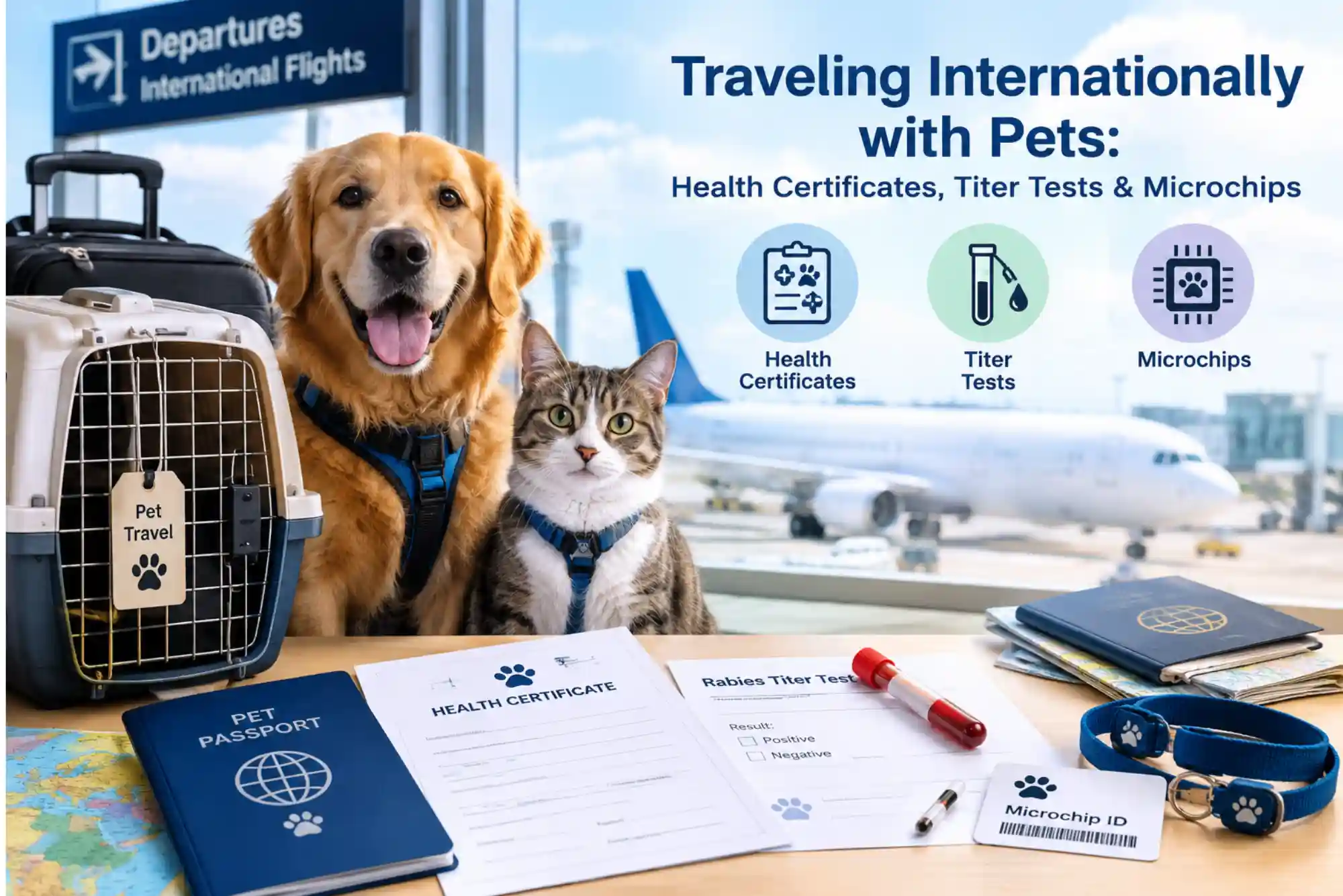
For many pet owners, the most important parts of international pet travel preparation are the health certificate, rabies vaccination, titer test, and microchip. These requirements can appear complicated at first because the rules vary according to the destination country, country of origin, type of animal, transit countries, and airline. Some destinations may require only basic veterinary documentation, while others can require a microchip, rabies vaccination, rabies antibody testing, parasite treatments, government endorsement, and a specific waiting period before the pet is permitted to enter.
This is why international pet travel should be planned well before the intended departure date. Waiting until the last few weeks can create serious problems if a blood test, vaccination, government endorsement, or import permit takes longer than expected. A carefully planned process gives pet owners enough time to meet every requirement without unnecessary stress.
For travelers researching professional pet transportation and international relocation information, Travels Flax provides a useful starting point for exploring pet travel services and related resources.
Why International Pet Travel Requires Careful Preparation
Every country has the authority to establish its own rules for animals entering its territory. These rules are generally designed around disease prevention, animal identification, and public health. Rabies is one of the most important concerns because it is a serious and potentially fatal disease, and international authorities use vaccination and testing requirements to reduce the risk of infected animals entering a country.
The rules can also change depending on where the pet is coming from. Countries often categorize other countries according to their rabies status or animal-health conditions. As a result, the same dog may face different requirements when traveling from one country compared with traveling from another.

Another important factor is the route. A journey with a direct flight may involve fewer regulatory considerations than a journey involving one or more transit countries. If a pet leaves the airport or passes through customs during transit, additional requirements may potentially apply.
Because regulations differ, pet owners should not rely only on information from friends, previous trips, or general internet articles. The current requirements of the destination country’s official veterinary or government authority should be checked before travel.
Understanding the International Pet Health Certificate
A health certificate is one of the most important documents associated with international pet travel. It generally confirms that a veterinarian has examined the animal and that the pet meets the applicable health requirements for the destination.
The exact certificate format depends on the destination. Some countries accept a certificate completed by an accredited veterinarian, while others require additional approval or endorsement from a government veterinary authority.
The timing of the examination can also be important. A destination may require the certificate to be issued within a certain number of days before arrival. This means that obtaining the certificate too early may make it invalid by the time the pet reaches its destination.
The information included in a health certificate commonly relates to the animal’s identification, owner, vaccination history, microchip information, and veterinary examination. Depending on the destination, additional laboratory results or parasite treatments may also need to be documented.
Accuracy is extremely important. The pet’s name, species, breed, sex, date of birth, microchip number, vaccination information, and owner’s details should be checked carefully. A discrepancy between the microchip number and the number written on the health certificate can create difficulties during inspection.
Why the Microchip Is So Important
A microchip is an important part of modern international pet travel because it provides permanent identification for the animal. Unlike a collar or tag, a properly registered microchip remains associated with the pet and can be scanned using an appropriate reader.
Many international destinations require pets to be microchipped before certain vaccinations are considered valid for entry purposes. This is particularly important for rabies vaccination. If a country’s regulations require the microchip to be implanted before the rabies vaccination, completing the steps in the wrong order could create additional requirements.
The microchip number should be consistent across all relevant travel documents. Before traveling, the owner should ask the veterinarian to scan the chip and verify that the number is readable. The number should then be carefully compared with the animal’s vaccination record and health certificate.
Microchip registration is also important. A microchip can identify an animal, but the identification system needs accurate owner information to make that identification useful if the pet becomes separated from the owner.
For people arranging international relocation with their animals, International Pet Travel can provide additional information about the broader process of preparing pets for international journeys.
What Is a Rabies Titer Test?
One of the most confusing parts of international pet travel is the rabies titer test. A rabies titer test is a laboratory blood test used to measure the level of rabies antibodies in a vaccinated animal.
Not every country requires this test. Some destinations accept valid rabies vaccination documentation without requiring an antibody test, while other destinations use the titer test as part of their entry process.
When a titer test is required, timing becomes particularly important. The pet normally needs to receive a qualifying rabies vaccination before the blood sample can be taken. The sample must then be tested by a laboratory recognized or accepted under the destination country’s rules.
Some destinations also require a waiting period between the blood test and the animal’s arrival. This is one of the main reasons international pet travel can require preparation several months in advance.
A pet owner who discovers the titer requirement only a few days before departure may not have enough time to complete the entire process. Therefore, the destination requirements should be reviewed as soon as international travel is being considered.
Rabies Vaccination and Travel Timing
Rabies vaccination is central to international pet movement regulations. Countries may have detailed rules about the age of the animal, the type of vaccine, the validity period, and the relationship between vaccination and microchip identification.
For example, a destination may require a microchip to be implanted before the qualifying rabies vaccination. It may also require the vaccination to remain valid on the date of entry.
Pet owners should therefore avoid treating vaccination as an isolated veterinary appointment. Instead, it should be considered part of a complete travel timeline.
The veterinarian can help determine which vaccinations are appropriate for the animal, while the destination authority determines which vaccinations are legally required for entry.
Keeping the original vaccination records is also important. Copies can be useful during travel, but original documents may be requested by authorities, veterinarians, airlines, or customs officials.
Why the Order of Requirements Matters
International pet travel is often easier to understand when the requirements are viewed as a connected process rather than separate tasks.
The microchip establishes the pet’s identity. The vaccination record establishes protection against required diseases. A titer test, when required, provides laboratory evidence of antibody levels. The health certificate then brings the relevant health and identification information together for the journey.
If one part is completed incorrectly, it can affect another part of the process. For example, if a destination requires the microchip to be implanted before the rabies vaccination, receiving the vaccination first may not satisfy the destination’s rules.
This is why pet owners should establish the requirements before scheduling veterinary appointments. A veterinarian can provide medical guidance, but the legal entry requirements come from the destination country.
Preparing for Airline Requirements
Government approval is only one part of international pet travel. Airlines have their own policies regarding animals, and these policies can differ from country import requirements.
An airline may have specific rules regarding approved carriers, carrier dimensions, pet weight, temperature restrictions, cabin travel, checked travel, or cargo transportation. Some airlines may restrict certain breeds or refuse animals during periods of extreme weather.
Pet owners should therefore check the airline’s current animal transportation policy before booking the flight. A pet that satisfies the destination country’s entry requirements may still need to meet additional airline conditions.
Travelers should also consider the duration of the journey. A short direct flight may be less complicated than a long itinerary involving several connections. Layovers can introduce additional stress for the animal and may create additional logistical considerations.
Professional international pet travel planning can help owners understand how veterinary documentation, airline requirements, and transportation arrangements fit together. Resources available through Travels Flax can also be useful when researching international pet movement.
Preparing Your Pet for Long-Distance Travel
Legal documentation is important, but the physical and emotional preparation of the pet also deserves attention. Long-distance travel can expose an animal to unfamiliar environments, sounds, people, transportation vehicles, and changes in routine.
One of the simplest ways to prepare a pet is to make the travel carrier familiar well before departure. Instead of introducing the carrier immediately before the flight, owners can allow the pet to become comfortable with it gradually.
The animal should also maintain a normal routine as much as possible before travel. Sudden changes in feeding, exercise, or sleeping patterns can add unnecessary stress.
Food and water planning should also be discussed with a veterinarian, especially for long journeys. Owners should understand how to manage the pet’s normal feeding and hydration needs during transportation.
Sedation should never be treated as a routine solution for air travel. Pet owners should speak with a veterinarian about any concerns regarding anxiety, motion sickness, or travel-related stress rather than giving medication without professional guidance.
What Happens at the Airport and Border?
International pet travel usually involves several stages. At the departure airport, airline personnel may review the animal’s travel documents and carrier. Depending on the route, additional veterinary or government checks may occur.
At the destination, border or veterinary authorities may inspect the pet’s microchip and documentation. If a country requires specific tests, vaccination records, certificates, or permits, officials may verify these documents before allowing the animal to enter.
The exact process varies by destination. Some countries have relatively straightforward procedures, while others have more detailed inspections and formal entry processes.
This is another reason documentation should be organized carefully. Keeping travel records together in a secure folder can make the process easier for the owner and the officials reviewing the documents.
Common Problems That Can Delay Pet Travel
Many international pet travel problems happen because preparation begins too late. A missed vaccination date, incorrect microchip number, incomplete certificate, or delayed laboratory result can affect the entire travel schedule.
Another common problem is assuming that requirements remain the same from one trip to another. Import rules can change, and a country that previously allowed a certain process may introduce new documentation or testing requirements.
Transit is another area that can be overlooked. Travelers sometimes focus only on the departure and final destination countries without checking whether the transit location has additional requirements.
The best approach is to create a travel timeline based on the official requirements for the specific journey. This timeline should account for veterinary appointments, vaccination dates, blood testing, waiting periods, certificate issuance, government endorsements, airline reservations, and the departure date.
How Far in Advance Should You Start?
There is no single preparation period that applies to every international pet journey. The required timeline depends heavily on the destination country’s rules.
For a simple trip, preparation may be relatively quick. For countries requiring a rabies titer test and a defined waiting period, preparation can take considerably longer.
Starting early provides flexibility. If a laboratory result does not meet the destination’s requirement or a document contains an error, there may be enough time to correct the issue.
Starting early also allows the pet owner to coordinate veterinary appointments and airline arrangements without having to make last-minute decisions.
Keeping Travel Documents Organized
A well-organized document system can make international pet travel much easier. Owners should maintain records of vaccination certificates, laboratory results, microchip information, health certificates, import permits when applicable, and airline documentation.
Digital copies can provide a useful backup, but travelers should also determine which original documents are required. Some authorities may specifically request original certificates or officially endorsed paperwork.
The microchip number should be checked against every document before departure. This simple verification can help prevent avoidable identification problems.
It is also useful to keep contact information for the veterinarian and any professional pet travel provider involved in the journey. Having these details available can be helpful if questions arise during the travel process.
International Pet Travel for Relocation
International relocation is different from a short vacation because the pet may need to remain in the destination country for an extended period. Owners relocating for work, education, family reasons, or permanent residence should consider both entry requirements and long-term animal care.
Before moving, it is useful to research veterinary services, pet-friendly housing, local registration requirements, and access to appropriate food and medications in the destination.
The move itself should be planned around the animal’s needs rather than treating the pet as an additional piece of luggage. A comfortable carrier, appropriate travel arrangements, and accurate documentation can make a major difference.
Owners can research professional assistance through International Pet Travel when planning a more complex international relocation.
Choosing Professional Pet Travel Assistance
International pet travel can be managed independently in some situations, but complicated routes may benefit from professional assistance. This can be particularly useful when several countries, connecting flights, testing requirements, or government approvals are involved.
A professional pet travel service may help coordinate different parts of the journey and explain the documentation process. However, pet owners should still verify important requirements with official government authorities and their veterinarian.
Professional support should complement, rather than replace, careful verification of current destination rules.
Final Thoughts on Traveling Internationally With Pets
International travel with a pet requires more preparation than an ordinary trip, but careful planning can make the process considerably easier. Health certificates, microchips, rabies vaccinations, and titer tests are important parts of the process for many international journeys, although the exact requirements vary by destination.
The most important principle is to start early. Do not wait until the flight is approaching before checking whether a rabies titer test, waiting period, government endorsement, or special certificate is required. Understanding the requirements in advance gives you time to complete each stage correctly.
A microchip should be checked carefully, vaccination records should be accurate, and any required laboratory testing should be completed according to the destination country’s rules. Airline policies should also be reviewed separately because satisfying government requirements does not automatically mean that an airline’s transportation requirements have been met.
With careful veterinary preparation, accurate documentation, appropriate transportation arrangements, and up-to-date research, international pet travel can be much more manageable. Whether the journey is a temporary trip or a permanent relocation, planning ahead helps protect the pet’s health and reduces unnecessary complications for the owner.
For additional information about international pet transportation and relocation, visit Travels Flax and explore the dedicated International Pet Travel resource.